Hermanni (Swedish: Hermanstad) is the 21st district of Helsinki, located in the north-eastern part of the city, east of Hämeentie. Hermanni is part of the Vallila basic district. Hermanni is further divided into Hermanninmäki, Kyläsaare and Hermanninranta. Also Wholesale market and Slaughterhouse belong to Hermann.
Hermann is home to around 6,000 people, most of whom currently live in Hermanninmäki. The Sörnäinen Prison, built in the 1880s, is located in the centre of Hermann and occupies a large part of Hermann's surface area.

Houses built at different times in Hermann create a historical layer dating back to the 1870s. Hermann has wooden houses built mainly in the late 19th and early 20th centuries, and apartment buildings from the 1950s-1960s, 1990s and 2000-2010s. Hermann has several parks and is a green district.
Hermann also has small industries, especially in Kyläsaari and Tukkutorti, but also in the north-western part of Hermann along Haukilahdenkatu, Vellamonkatu and Hämeentie.

Hermann's postal codes are 00550 for Hermanninmäki (including Vallila and Arabianranta) and 00580 for Etelä-Hermann and Kyläsaari (including Verkkosaari/Kalasatama).
Two polling stations in Hermann
Hermanni is divided into two voting districts
- Hermanni A (021A): area of Hermanninmäki south of Saarenkatu
- Hermanni B (021B): the northern part of Hermanni, north of Saarenkatu.
In the 2023 parliamentary elections, the main parties in Hermanni A were: SDP 24.7 %, Greens 20.5 %, Coalition 19.7 %, Left Alliance 17.2 % and True Finns 8.0 %. The three candidates with the most votes were: Elina Valtonen (CoR) 148 votes, Nasima Razmyar (SDP) 125 votes and Eveliina Heinäluoma (SDP) 105 votes.
In the 2023 parliamentary elections, the main parties in Hermann B were: Left Alliance 24.8 %, SDP 20.8 %, Greens 15.5 %, Coalition 11.9 % and True Finns 10.3 %. The three candidates with the most votes were: Jussi Halla-Aho (PS) 97 votes, Minja Koskela (Left) 95 votes and Mai Kivelä (Left) 71 votes.
Hermanni was a ”wooden house suburb” in the early 1900s”
Hermann is named after Herman Standertskjöld-Nordenstam. He was a baron and owner of Kumpula Manor in the 1880s. Standertsköjld separated the estate's lands into the present Hermanninmäki area and began to rent out residential plots, which resulted in the development of Hermanni into a dense for a wooded area.
Hermann's shanty town was the most densely populated area of Helsinki, built without much planning. A family of five might not even have one room to themselves. There were a few families living in wooden houses, each with a stove room. The houses had no sewage system, but had hose and water posts in the yard. The stalls in the yards supported a large number of pigs. In the absence of piped water and sewers, epidemics and infant mortality were common.
Wooden Hermann was a notorious area and also under the surveillance of the vice squad, as sex workers also stayed in the suburb.
In 1893, the City of Helsinki bought the Kumpula Manor lands, which included Hermanni. Hermanni was annexed to Helsinki in 1906.

Lindelöfi machine factory
The largest industrial plant in Hermann was the Lindelöf machine factory, built in 1889, which, after becoming a limited company, was called Ilmarinen. The factory was founded by Leonard Lindelöf, a Master of Philosophy, and produced weights and scales.
In 1889-1892, an entire factory community was built on the area bordered by Saaren, Oihonen, Violan and Orioninkatu streets, which was named Toimela - a temperance society of the same name was later established in Hermann. The factory employed just under a hundred workers. The factory initially occupied a whole block of land.
In 1895, a fire destroyed the factory except for the stone foundry. Operations continued on a smaller scale until the company went bankrupt. Later, the site was occupied by the Finnish Iron Slag Factories Ltd and the G. J. Sundberg Fish Canning Factory until 1950.


From a woodland to a stone-built area in the 50s
In 1941, a zoning plan was drawn up for the area, which was converted into an apartment block. The deteriorating wooden buildings were mainly demolished in the 1950s and replaced by stone houses. Only a few of the wooden houses remain. Built in the 1950s, the area is a typical example of 1950s urban development. Between the mainly plastered buildings, in many places, the landforms and bare rocks are visible. When the so-called stone Hermann was built, the principle was to preserve the greenery typical of the area.
Several of the houses from the 1950s and early 1960s were designed by architect Else Aropaltio, whose buildings were characterised by a strong sense of aesthetics. The houses designed by Aropalttio are located on Helminkatu, Orioninkatu and Hämeentie. By far the largest number of houses designed by Aropaltio can be found in Lauttasaari.

Modern South Hermanni built on Veterinary Medicine land
In the early 2000s, the following were adopted South Hermann and a new apartment block for more than 2000 residents was built on the land of the former Veterinary College. The former veterinary college (including a small animal clinic) was demolished and the veterinary facilities moved to Viikki in 2006. A more compact area than the older Hermann was built between 2005 and 2015. The opening of the area was celebrated on 22 September 2012 at the Veterinary Park and Windmill Square. Many of the streets in the area are named after former cinemas: Allotria, Rialto, Tuulensuu, Plaza, Fenix and Tenho.
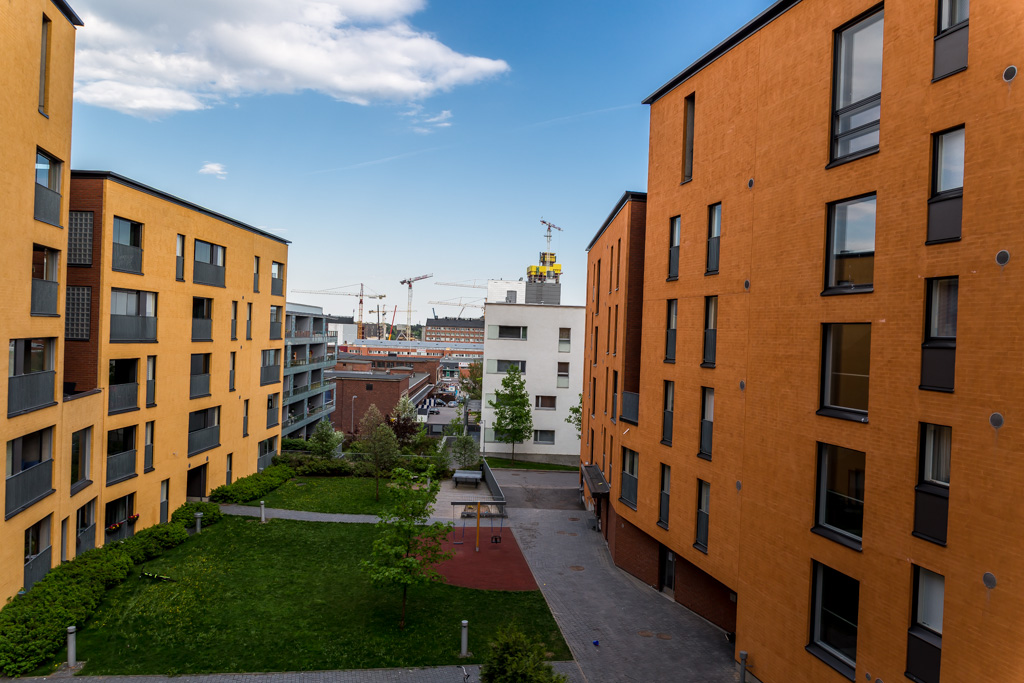
In the future, residential buildings will be built in Kyläsaari and Hermanninranta.
Good connections to neighbouring towns and beyond
Services You won't find much in Hermann, but you will find some: a Lidl and Alko on the Tukkutor, a few restaurants and pizzerias, a couple of bars, an antique shop, a sports and tool shop, a couple of barbershops, a laundry, a garage, a gym, a public sauna and a recycling centre for the metropolitan area.
However, there are plenty of services in the nearby areas of Vallila, Arabia, Kallio and Kalasatama. Some residents have a short distance to the Arabia shopping centre, others to Vallila and Kurvi, and others to Red in Kalasatama. The nearest libraries are located in Vallila on Päijänteentieteete and in the Red shopping centre.
Located in Hermann, the Wholesale market the area contains a concentration of wholesale outlets and Slaughterhouse an area with numerous restaurants and open urban space.

Hermann to the public transport index include Hämeentie trams (6,8) and buses, as well as buses running along Hermann's Rantatiet. Sörnäinen and Kalasatama metro stations are also a short distance away for some residents. Public transport is therefore one of the best in Helsinki.

Hermann Neighbouring neighbourhoods are Vallila, Toukola, Arabianranta, Sörnäinen and Kalasatama.
Famous Herman women
The following well-known people live (or have lived) in Hermann
- Mariska (Anna Maria Rahikainen), muusikko (ei asu enää)
- Leo Friman (Freeman), musician
- Tumppi Varonen aka Tuomo Valokainen, musician and former city councillor
- Julia Thurén, toimittaja ja tietokirjailija (muutti pois 2025)
- Eeva Vekki, comedian and screenwriter
- Stig aka Pasi Siitonen, musician.
Lactic acid bacterium named after Hermann
Researchers at the University of Helsinki's Faculty of Veterinary Medicine named a species of lactic acid bacteria they discovered in 2004 after Hermann. Enterococcus hermanniensis is a tribute to the faculty's old Hermann campus, from which the faculty moved to Viikki in 2004-2006. Enterococcus stands for enterococcus, a genus of gram-positive enterococcus bacteria. The latter part of the name means ”Hermannian”.
Päivitetty 29.12.2025
2 replies on “Hermannin kaupunginosa”
That list of celebrities reminds me that I understand that the singer Mariska is a native of Hermann and has lived in Hermann for most of her life in the house on the corner of Hämeentie and Vegankatu. This is what I have understood from articles on the internet. On the subject of wooden houses, looking at old photos, the one wooden house on the cliff between Saarenkatu and Vegankatu 12 was built in an amazing place. On top of that steep cliff. There's a lot of stories about old Hermann in the biography of Tumppi Varonen.
Thank you Petsku! This was both new information for me. I didn't know about Mariska's hermanicity, I added it to the website now. It has been my policy to add information only if it is public. And Mariska's Hermann background was indeed found in many newspaper articles.
I didn't know about Tumppi Varonen's novels, so I have now put the first novel on reserve.